Looking back on going live!
Posted by Jennifer Bernatow-Parsons in Uncategorized on April 3, 2017
Recently, I conducted a live webinar as part of an online course. Having viewed just a couple of webinars prior to this, it was definitely out of my comfort zone. However, like most things in life, this was a good experience for me.
I get very nervous before presentations and this was no different. Thank goodness I had practiced a lot and knew a lot about the site I was sharing. At least I wasn’t fumbling through new information.
The first thing I learned is that when you open an extra tab on your computer and share your screen, the tab you need might just be hidden behind Zoom’s drop down, screen share tab. Oops!
Another thing that I learned is that when I practice too much it becomes almost scripted and I get thrown just a bit if things don’t go exactly according to that script. I think it would be better for me to use talking points and to try to relax and engage with my audience rather than worry so much about touching all of the bases.
I missed a few responses from my participants that I noticed later when I watched the video. (Sorry!) It’s harder than one might think when you are in the moment to make sure to observe every little detail. I think part of this was that I felt like time was flying much faster than when I had practiced. However, I realized after I presented that we had really started a few minutes late while waiting on a few participants. So then when I looked at the clock mid way through I felt like I was further behind than I actually was. Consequently, I zipped through my ending.
Overall, I felt like it was positive experience though. The participants were very friendly and seemed to enjoy and understand the content and that was the point of the presentation in the first place.
Why is my audience fishing for information?
Posted by Jennifer Bernatow-Parsons in Uncategorized on February 19, 2017
When approaching instructional design, keep CARP in mind!
The CARP principles are crucial when creating a visual presentation. They ensure that the material that presented holds the audiences attention and facilitates the learning and memory of the material presented.
I believe contrast is the most important because it helps to emphasize important concepts within the presentation. While the other principles are important to the flow of a project, I believe that contrast does the most to deliver the core content to the viewer. The use of color and size of content specifically draw the eye and focus of your intended audience towards important concepts.
Alignment is important in your presentation because it adds structure and organization to a project. Following this principle ensures that your presentation or slide is easy to follow and looks and feels well planned out.
Repetition allows your viewers to feel a comfort and familiarity within your project. When there is a bit of predictability within a project, viewers are more likely to be able to find information that they are looking for and more easily absorb the information. Topic headings are clear and distinguished from content for example.
Proximity also adds to the organization feel of a project. Within this principle I feel one of the most important concepts is including enough blank space in a project. Always remember that less is more. Especially in a slide presentation, viewers don’t want to see slides that are filled with text and read to them. Keep it simple.
Watch “Speed Racer Tarver Teachers” on YouTube
Posted by Jennifer Bernatow-Parsons in Uncategorized on February 28, 2016
Movement matters. If you want your students to be active, you have to model it. Here are some of my colleagues and myself getting a little exercise.
Privacy in Social Media
Posted by Jennifer Bernatow-Parsons in Social Media on November 15, 2015
Privacy in social media is not something that I’m overly concerned with personally. I am very careful about what I post online and like to think that I have a common sense approach. I personally do not spend much time worrying about what I post on my base camp site or NLS because everything I post there is meant in a professional context and I conduct myself as such.
I like to keep a clear line between my personal and professional life. I have two Twitter accounts for instance, so that it’s easy to keep them separate. I feel like the people in my networks appreciate that as well. My personal Twitter friends don’t want to see all my likes and retweets about educational topics and people seeking me out professionally may not want the latest information on the tour Prince is now planning in Europe.
All of my personal accounts are set with privacy settings, not because I ever post anything inappropriate like Carly McKinney, but because not all the world needs to know where I am and who I am with at all times. I do feel that as teachers we are allowed to have a life outside of school, however, if you choose to advertise it on social media, you lose the right to your privacy over it. You open that door.
I don’t connect with my students or anyone under the age of 18 on social media other than family members. First of all, my students are way too young in my opinion to be engaging in social media. Second, I think it helps to keep a healthy respect and distance.
People have mentioned someone taking an unflattering moment and posting it online. Unfortunately, that is the world we live in at this point and it’s a valid concern. However, worrying about something you can’t control is not healthy. I choose not to feed into that fear.
As parents and educators, it is our job to teach the children in our care how to navigate all of this because they don’t remember a time without it. My advice to my own kids has always been that if you wouldn’t stand on a street corner and yell it, or tell it to your grandma then the internet is not the platform for it. I’m proud to say that they seem to understand that.
Five Keys For Establishing Your Tribe
Posted by Jennifer Bernatow-Parsons in Uncategorized on October 18, 2015

Source: Five Keys For Establishing Your Tribe
I found this post timely and useful as I am working to gather my own tribe on a new networked learning space. I have several colleagues who teach first grade in the same district as I do. Some of them happen to teach with me at my school, others I have taught with at previous schools or kept in touch with since my days of student teaching.
The very essence of teaching I have found bonds us to each other. We talk about the ups and the downs. We lean on each other when things get tough and we celebrate each other’s successes. It’s natural for our conversations even in settings outside the classroom to veer towards school. As our district changes curriculum or challenges arrive with the new math program, it’s easy to talk with this group about the pros and cons and to share ideas. I’ve decided to take this experience online with this group in order to make this sharing and learning easier and more consistent.
The lasting connections that I have made with these educators challenges me and lifts me up. There is nothing better than being able to share difficult and rewarding experiences with my tribe.
CODING EMPOWERMENT
Posted by Jennifer Bernatow-Parsons in Have you heard? on October 18, 2015

I saw this on Twitter just today. This really struck me as I am newly interested in coding and am going to be taking a course very soon. Also, I am a big advocate of getting educational opportunities into areas and populations where it is frequently denied. I’m so glad to see this door being opened to more populations.
SIGHT WORD STRATEGIES
Posted by Jennifer Bernatow-Parsons in 1st grade curriculum on October 18, 2015
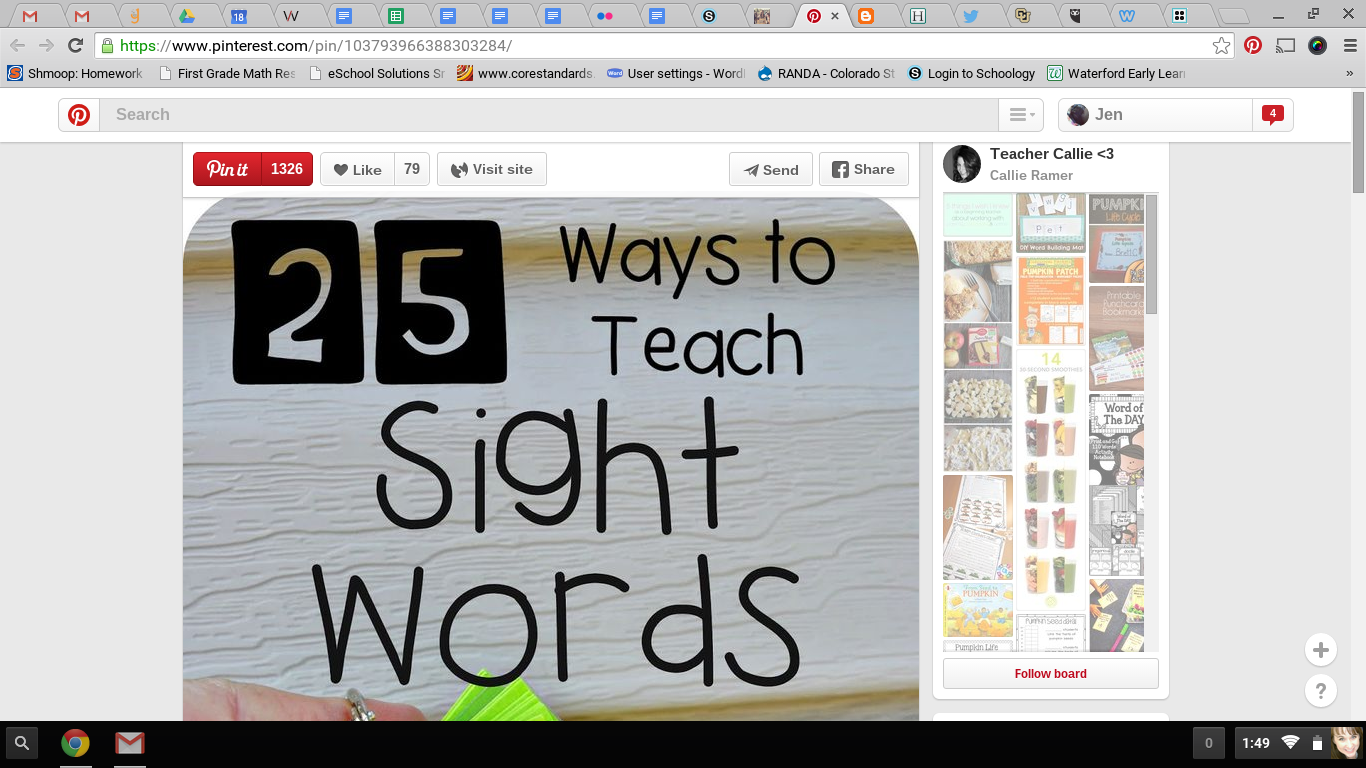
https://www.pinterest.com/pin/103793966388303284/
I found this pin giving a variety of different ways to teach sight words and my class needs a lot of work in this area this year. I feel like I can use some of these strategies with parent volunteers to help us move forward. I’m always looking for a way to make this necessary component to reading instruction more engaging and useful.

 JENNIFER BERNATOW-PARSONS ~ Adventures in Teaching and Tech